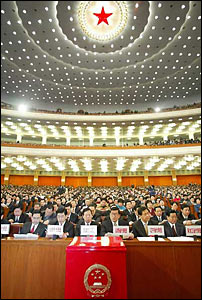
I. The nature and position of the system of people’s congress The system of people’s congress is an organizational form for the state power in China. It is China’s fundamental political system.
The power in the People’s Republic of China belongs to the people and the organ for the people to exercise state power is the National People’s Congress and local people’s congresses at all levels.
The National People’s Congress (NPC) and local people’s congresses are established through democratic elections, responsible to and supervised by the people.
State administrative, judicial and procuratorial organs are created by, responsible to and supervised by the people’s congresses.
The National People’s Congress is the highest organ of state power. Local people’s congresses are local organs of state power.
II. The National People’s Congress
1. The composition and term of office of the NPC
The NPC is composed of deputies elected from the provinces, autonomous regions and municipalities directly under the Central Government and deputies elected by the armed forces.
Deputies to the NPC are organized into delegations according to the units they are elected from. Each delegation is headed y a chairman and vice chairmen.
All the ethnic minorities are entitled to appropriate representation.
The NPC is elected for a term of five years.
The Standing Committee of the NPC must ensure the completion of election of deputies to the succeeding NPC two months prior to the expiration of the term of office of the current NPC. Should extraordinary circumstances prevent such an election, it may be postponed and the term of office of the current NPC extended by the decision of a vote of more than two-thirds of all those on the Standing Committee of the current NPC. The election of deputies to the succeeding NPC must be completed within one year after the termination of such extraordinary circumstances.
The NPC meets in session once a year and is convened by its Standing Committee.
A session of the NPC may be convened at any time the Standing Committee deems it necessary or when more than one-fifth of the deputies to the NPC so propose.
2. The functions and powers of the NPC
The NPC exercises the following functions and powers:
(1) to amend the Constitution;
The amendment of the Constitution shall be proposed by the Standing Committee of the NPC or more than one-fifth of the deputies to the NPC and can only be adopted by a majority of no less than two-thirds of the deputies to the NPC.
(2) to supervise the enforcement of the Constitution;
(3) to enact and amend basic laws governing criminal offences, civil affairs, the state organs and other matters;
(4) to elect the President and the Vice President of the People’s Republic of China;
(5) to decided on the choice of the Premier of the State Council upon nomination by the President, and on the choice of the Vice Premiers, State Councilors, Ministers in charge of ministries or commissions, the Auditor-General and the Secretary-general of the State Council upon nomination by the Premier;
(6) to elect the Chairman of the Central Military commission and, upon nomination by the Chairman, to decide on the choice of all other members of the Central Military Commission;
(7) to elect the President of the Supreme People’s Court;
(8) to elect the Procurator-General of the Supreme People’s Procuratorate;
(9) to examine and approve the plan for national economic and social development and the report on its implementation;
(10) to examine and approve the state budget and the report on its implementation;
(11) to alter or annul inappropriate decisions of the Standing Committee of the NPC;
(12) to approve the establishment of provinces, autonomous regions, and municipalities directly under the Central Government;
(13) to decide on the establishment of special administrative regions and the systems to be instituted there;
(14) to decide on questions of war and peace; and
(15) to exercise such other functions and powers as the highest organ of state power should exercise.
(16) The NPC has the right to remove the following functionaries:
1) The Chairman and Vice Chairman of the People’s Republic of China;
2) The Premier of the State Council, the Vice Premiers, State Councilors, Ministers in charge of the ministries or commissions, the Auditor-General and the Secretary-general of the State Council;
3) The Chairman, Vice Chairman and other members of the Central Military Commission;
4) The President of the Supreme People’s Court; and
5) The Procurator-General of the Supreme People’s Procuratorate.
III. The Standing Committee of the NPC
The Standing Committee of the NPC is the permanent organ of the NPC. When the NPC is not in session, the Standing Committee performs the right of the highest organ of state power. It is responsible to and reports to the NPC.
1. The composition and term of office of the Standing Committee of the NPC
The Standing Committee of the NPC is composed of the Chairman, Vice Chairmen, Secretary-general and members.
Ethnic minorities are entitled to appropriate representation on the Standing Committee.
The NPC elects and has the power to recall members of the Standing Committee.
Those on the Standing Committee shall not serve in state administrative, judicial and procuratorial organs.
The term of office of the Standing Committee corresponds with that of the NPC and it shall exercise its power until a succeeding Standing Committee is elected by the succeeding NPC.
The Chairman and Vice Chairmen of the NPC shall not serve more than two consecutive terms.
2. The functions and powers of the Standing Committee
The Standing Committee of NPC exercises the following functions and powers:
(1) to interpret the Constitution and supervise its enforcement;
(2) to enact and amend laws, with the exception of those which should be enacted by the NPC;
(3) to partially supplement and amend, when the NPC is not in session, laws enacted by the NPC provided that the basic principles of these laws are not contravened;
(4) to interpret laws;
(5) to review and approve, when the NPC is not in session, partial adjustments to the plan for national economic and social development or to the state budget that prove necessary in the course of their implementation;
(6) to supervise the work of the State Council, the Central Military Commission, the Supreme People’s Court and the Supreme People’s Procuratorate;
(7) to annul those administrative rules and regulations, decisions or orders of the State Council that contravene the Constitution or the law;
(8) to annul those local regulations or decisions of the organs of state power of provinces, autonomous regions, and municipalities directly under the Central Government that contravene the Constitution, the law or the administrative rules and regulations;
(9) to decide, when the NPC is not in session, on the choice of Ministers in charge of ministries or commissions, the Auditor-General or the Secretary-general of the State Council upon nomination by the Premier of the State Council;
(10) to decide, upon nomination by the Chairman of the Central Military Commission, on the choice of other members of the Commission, when the NPC is not in session;
(11) to appoint or remove, at the recommendation of the President of the Supreme People’s Court, the Vice Presidents and Judges of the Supreme People’s Court, members of its Judicial Committee and the President of the Military Court;
(12) to appoint or remove, at the recommendation of the Procurator-General of the Supreme People’s Procuratorate, the Deputy Procurators-General and the procurators of the Supreme People’s Procuratorate, members of its Procuratorial Committee and the Chief Procurator of the military procuratorate, and to approve the appointment or removal of the chief procurators of the people’s procuratorates of provinces, autonomous regions, and municipalities directly under the Central Government;
(13) to decide on the appointment or recall of plenipotentiary representatives abroad;
(14) to decide on the ratification or abrogation of treaties and important agreements concluded with foreign states;
(15) to institute systems of titles and ranks for military and diplomatic personnel and of other specific titles and ranks;
(16) to institute state medals and titles or honor and decide on their conferment;
(17) to decide on the granting of special pardons;
(18) to decide, when the NPC is not in session, on the proclamation of a state of war in the event of an armed attack on the country or in fulfillment of international treaty obligations concerning common defense against aggression;
(19) to decide on general mobilization or partial mobilization;
(20) to decide on the imposition of martial law throughout the country or in particular provinces, autonomous regions, or municipalities directly under the Central Government; and
(21) to exercise such other functions and powers as the NPC may assign to it.
3. Organs of the Standing Committee
The Chairman of the Standing Committee of the NPC directs the work of the Standing Committee and convenes its meetings. The Vice Chairmen and the Secretary-general assist the Chairman in his work.
The Chairman, Vice Chairmen and Secretary-general constitute the Council of Chairmen which handles the important day-to-day work of the Standing Committee of the NPC.
The Standing Committee of the NPC establishes a deputy credentials examination committee to examine the credentials of the deputies to the current NPC through by-elections and those newly elected to the succeeding NPC.
The credentials examination committee is composed of the chairman, vice chairman and members, nominated from among the members of the Standing Committee by the Council of Chairmen and agreed upon by the plenary session of the Standing Committee.
The NPC establishes special committees to examine, discuss and draw up relevant bills and draft solutions under the direction of the NPC and its Standing Committee.
When the NPC is not in session, its special committees work under the direction of the Standing Committee of the NPC.
The 9th NPC has established nine special committees, namely the ethnic groups committee, the law committee, the finance and economic committee, the education, science, culture and health committee, the foreign affairs committee, the overseas Chinese committee, the civil and judicial affairs committee, the environment and resources protection committee and the agriculture and rural areas committee.
Normally, the special committees are chaired by Vice Chairmen or members of the Standing Committee of the NPC.
The NPC and its Standing Committee may, when they deem it necessary, appoint committees of inquiry into specific questions and adopt relevant resolutions in the light of their reports.
IV. Local people’s congresses and their standing committees
People’s congresses are established in provinces, autonomous regions, municipalities directly under the Central Government, autonomous prefectures, counties, autonomous counties, cities, municipal districts, townships, ethnic townships and towns. Standing committees are established at people’s congresses at and above the county level.
1. The term of office of local people’s congresses
The term of office of people’s congresses of provinces, autonomous regions and municipalities directly under the Central Government and cities divided into districts is five years.
The term of office of the people’s congresses of counties, autonomous counties, cities not divided into districts, municipal districts, townships, ethnic townships, and towns is three years.
2. The functions and powers of local people’s congresses
Local people’s congresses at various levels ensure the observance and implementation of the Constitution and the law and the administrative rules and regulations in their respective administrative areas. Within the limits of their authority as prescribed by law, they adopt and issue resolutions and examine and decide on plans for local economic and cultural development and for the development of public services.
Local people’s congresses at and above the county level shall examine and approve the plans for economic and social development and the budgets of their respective administrative areas and examine and approve the reports on their implementation. They have the power to alter or annul inappropriate decisions of their own standing committees.
The people’s congresses of provinces, autonomous regions, municipalities directly under the Central Government, of cities which are capitals of the provinces or autonomous regions as well as large cities approved by the State Council have the right to adopt local regulations in the light of their regional political, economic and cultural characteristics.
Local people’s congresses at their respective levels elect and have the power to recall governors and deputy governors, or mayors and deputy mayors, or heads and deputy heads of counties, districts, townships and towns.
Local people’s congresses at and above the county level elect and have the power to recall presidents of people’s courts and chief procurators of people’s procuratorates at the corresponding level.
The election or recall of chief procurators of people’s procuratorates shall be reported to the chief procurators of the people’s procucratorates at the next higher level for submission to the standing committees of the people’s congresses at the corresponding level for approval.
3. The composition, functions and powers of the standing committees of local people’s congresses
The standing committee of a local people’s congress at and above the county level is composed of a chairman, vice chairmen and members, and is responsible and reports on its work to the people’s congress at the corresponding level.
A local people’s congress at or above the county level elects and has the power to recall members of its standing committee.
No one on the standing committee of a local people’s congress at or above the county level shall hold office in state administrative, judicial and procuratorial organs.
The standing committee of a local people’s congress at or above the county level discusses and decides on major issues in all fields of work in its administrative areas; supervises the work of the people’s government, people’s court and people’s procuratorate at the corresponding level; annuls inappropriate decisions and orders of the people’s government at the corresponding level; annuls inappropriate resolutions of the people’s congress at the next lower level; decides on the appointment or removal of functionaries of state organs within the limits of its authority as prescribed by law; and, when the people’s congress at the corresponding level is not in session, recalls individual deputies to the people’s congress at the next higher level and elects individual deputies to fill vacancies in that people’s congress.
The standing committees of people’s congresses of the provinces, autonomous regions, municipalities directly under the Central Government, cities which are capitals of provinces or autonomous regions as well as large cities approved by the State Council have the power to adopt local regulations in the light of the local regional political, economic and cultural characteristics, when the people’s congresses at the corresponding level are not in session.
V. People’s congresses of townships, ethnic townships and towns
The term of office of people’s congresses of townships, ethnic townships and towns is three years. Such a people’s congress establishes a presidium headed by the chairman and vice chairmen. The presidium is responsible for convening the meetings of the people’s congress.
The functions and powers of the people’s congresses of townships, ethnic townships and towns mainly include the following:
1. The power to examine and decide on major issues
To decide on the plans for the construction of local economy, cultural undertakings and public understandings, in accordance with national plans; to examine and approve local financial budgets and report on the implementation of the budgets; and to decide on the implementation plans for civil work in their own regions.
2. The power to elect, appoint and remove local functionaries
To elect or recall the heads and deputy heads of the townships, ethnic townships and towns.
Candidates for the heads and deputy heads of the townships, ethnic townships and towns are to be nominated by the presidiums of the people’s congresses or no less than ten deputies.
The presidiums or more than one-fifth of the deputies to the people’s congresses of the townships, ethnic townships and towns may propose the removal of the above-mentioned functionaries when the people’s congresses are in session. The proposal of removal are submitted to the congresses by the presidiums.
All elections are by secret ballot.
3. The power of supervision
To examine the work report of the governments of the townships, ethnic townships and towns, annul their inappropriate decisions and decrees, and recall or remove functionaries making up the governments of the townships, ethnic townships and towns.
VI. Deputies to the people’s congresses
1. The election of deputies
Deputies to the NPC are elected by the people’s congresses of the provinces, autonomous regions and municipalities directly under the Central Government and by the armed forces.
Deputies to the people’s congresses of the provinces, autonomous regions, municipalities directly under the Central Government and cities divided into districts are elected by the people’s congresses at the next lower level.
Deputies to the people’s congresses of counties, cities not divided into districts, municipal districts, townships, ethnic townships and towns are elected directly by the electorates.
2. The rights of the deputies
(1) During the session
1) Right to draft proposals for bills;
2) Right to raise suggestions, criticisms and put forward opinions;
3) Right to vote in election and decide on appointment;
4) Right to examine issues;
5) Right to propose the recall of functionaries;
6) Right to raise bills for questioning and conduct hearings;
7) Right to draft suggestions;
8) Right to vote; and
9) Right to impunity.
(2) Not in session
1) Right to maintain contact with original voting units;
2) Right to inspect;
3) Right to propose provisional sessions;
4) Right to audit other meetings;
5) Right to participate in committees for investigating specified issues;
6) Right to sit in meetings of the people’s congress and its standing committee of the original unit the deputy is elected from;
7) Right of special protection of the person; and
8) Right to privileges for deputies.